On this page
Which original retatrutide COAs can you open?
The two certificates below cover named powder-vial lots. Each includes a chromatogram, peak table, analytical methods and approval details. The previews show page one; open or download the complete PDFs to read both pages.12
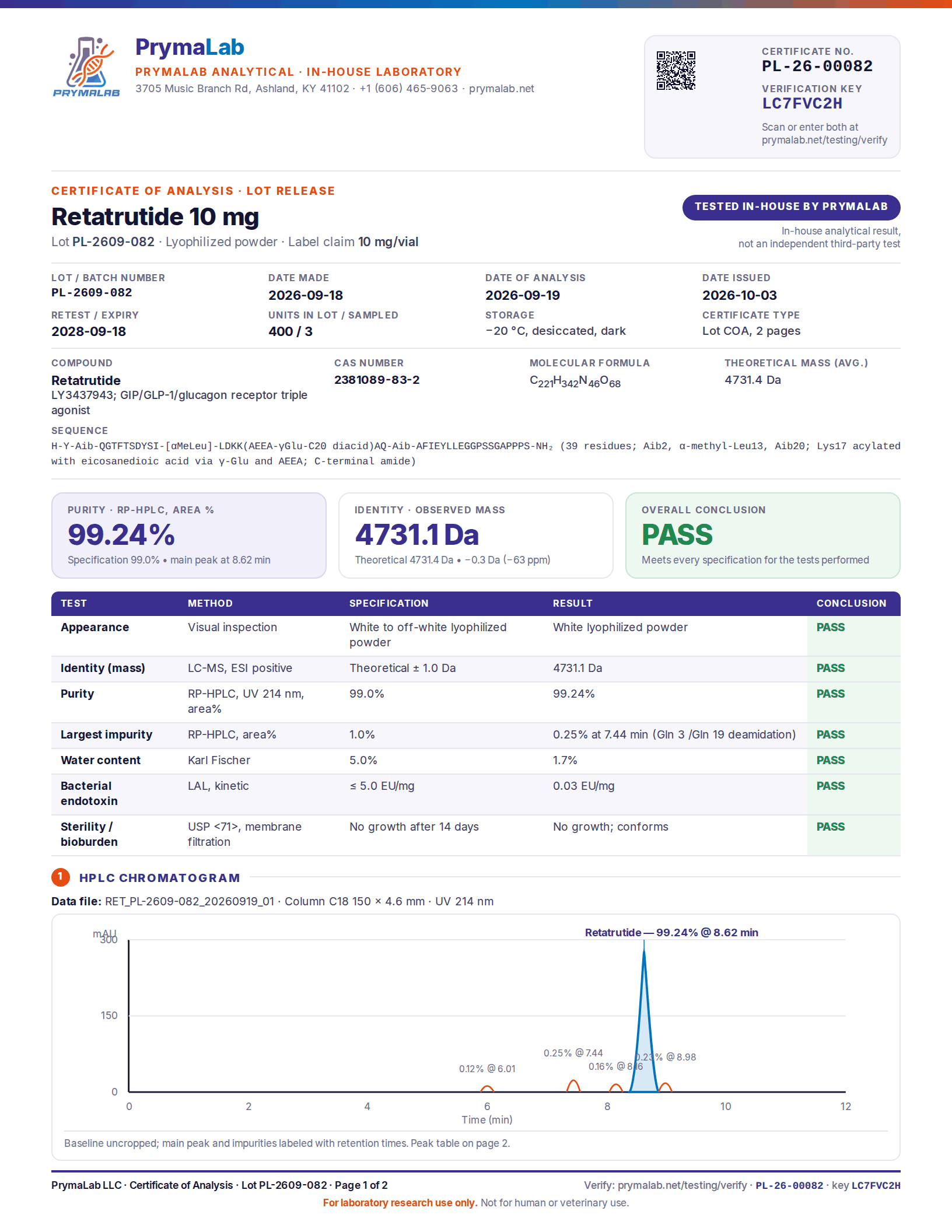
Retatrutide 10 mg vial
Lot PL-2609-082
Certificate PL-26-00082
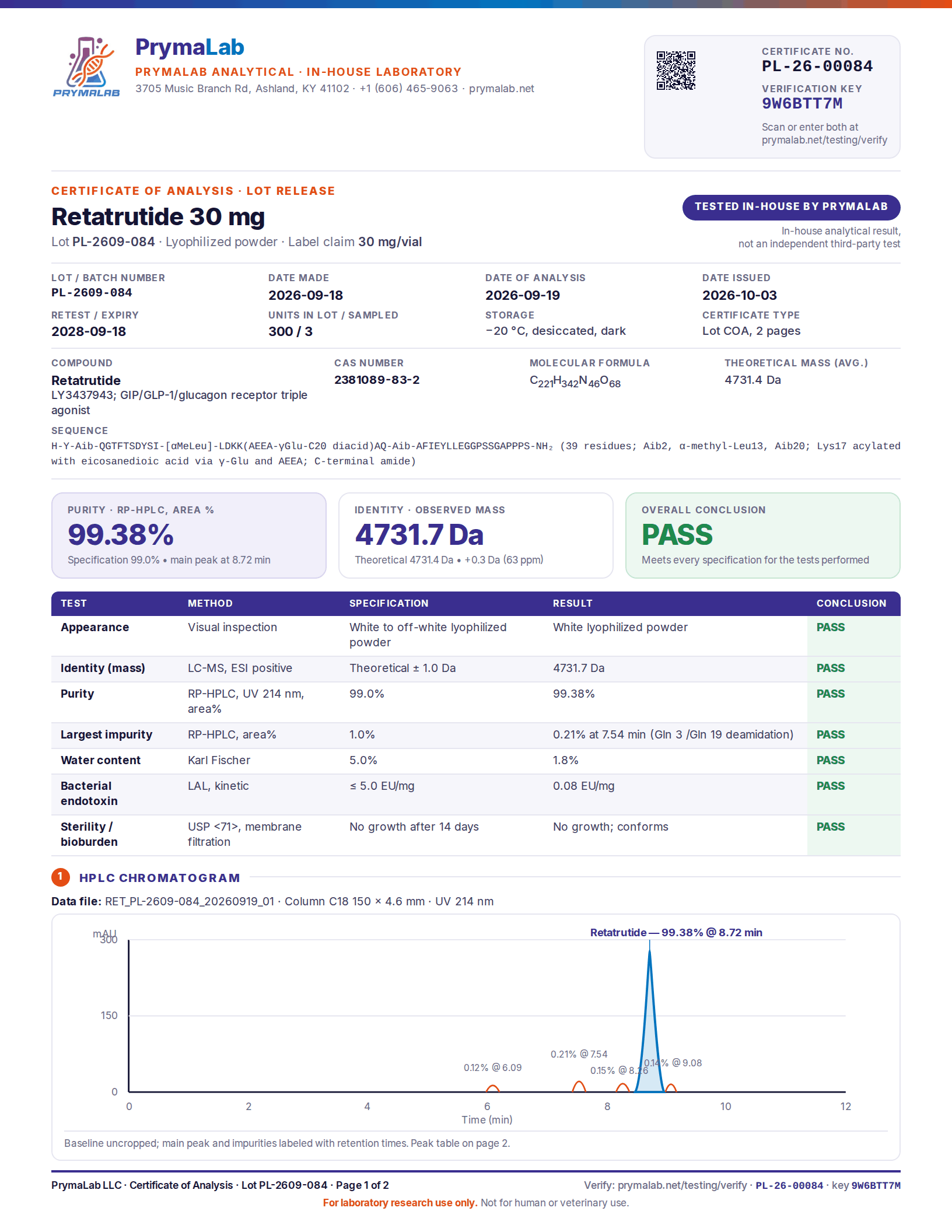
Retatrutide 30 mg vial
Lot PL-2609-084
Certificate PL-26-00084
Who performed the tests?
PrymaLab Analytical, the supplier's own laboratory, issued both reports. These are in-house results, not independent third-party testing. Both state that no outside laboratory reports are attached.12
These dates appear on both original vial certificates. A certificate's issue date is distinct from its analysis date and its retest or expiry field.12
How do you match a COA to a vial or pen?
Compare the compound, supplied form, total amount and exact lot number on the container with the document. A matching brand or milligram amount alone does not establish a lot match. Keep both pages together so the result stays attached to its method and approval record.
| Format | Lot or specification | Document scope |
|---|---|---|
| 10 mg powder vial | PL-2609-082 | Lot certificate PL-26-00082; powder SDS PL-SDS-140.13 |
| 30 mg powder vial | PL-2609-084 | Lot certificate PL-26-00084; powder SDS PL-SDS-140.23 |
| 15 mg / 3 mL pen | 5 mg/mL by calculation | Pen SDS PL-SDS-141 describes the formulation and handling; this set has no finished-pen lot certificate.4 |
The 10 mg report records 3 sampled units from a 400-unit lot; the 30 mg report records 3 from a 300-unit lot. These sampling details identify the scope of the submitted results. They are not a record of individual testing of every container.12
What is the difference between purity, identity and vial content?
A purity percentage, a molecular-mass result and a milligram amount answer different questions. Read the test name beside the number before comparing products.
| Measurement | Reported result | How to read it |
|---|---|---|
| Purity | 99.24% for the 10 mg lot; 99.38% for the 30 mg lot. | RP-HPLC area percentage, UV detection at 214 nm, using a C18 column.12 |
| Identity by mass | 4731.1 Da and 4731.7 Da, respectively. | LC-MS, ESI positive; both are compared with 4731.4 Da theoretical mass and a ±1.0 Da acceptance range.12 |
| Amount per vial | 10 mg and 30 mg label claims. | The certificates do not provide a separate quantitative assay result for measured milligrams per vial.12 |
The HPLC calculation divides the main peak's integrated area by the total integrated area. It describes the chromatogram, not the fraction of the promised vial fill delivered. Multiplying a vial's stated milligrams by its HPLC percentage does not produce a measured content result.
For a content question, request the quantitative assay method and its result for the matching lot. For an identity question, review the mass result and supporting method. Neither answer can be replaced by a large purity percentage alone.
Do the vial COAs report endotoxin and sterility tests?
Yes. Both originals contain separate results for these tests. They appear in the page-one test table; page two identifies the additional tests as performed in-house.12
| Test | 10 mg lot | 30 mg lot |
|---|---|---|
| Bacterial endotoxin · kinetic LAL | 0.03 EU/mg | 0.08 EU/mg |
| Sterility / bioburden · USP <71> membrane filtration | No growth; conforms | No growth; conforms |
The endotoxin specification is ≤5.0 EU/mg. The growth-test specification is no growth after 14 days. These are the certificate's reported findings, not results independently reproduced by this website.12
HPLC purity itself supplies neither result: the separate test rows do. Read all of them together. Results for sampled powder-vial lots do not certify a different batch, a separately filled pen or material after subsequent handling. For a deeper review, request the underlying endotoxin and sterility reports identified on page two.
Does either vial certificate cover the 15 mg autoinjector?
The two COAs identify powder-vial lots. The pen has a separate safety data sheet describing 15 mg in 3 mL, which works out to 5 mg/mL. That concentration is arithmetic based on the specification, not a finished-pen assay result.4
A useful finished-pen file would identify the pen lot, tested formulation, content result and relevant device-output documentation. A safety data sheet explains the product's composition, hazards and handling; it does not replace that batch record.
The total volume and concentration also do not establish milligrams per click. That requires the exact device's verified delivered volume and calibration. This document set contains no per-click calibration or finished-pen COA.
What do the storage instructions and retest date mean?
The two original safety data sheets are revision 1.0, dated 3 October 2026. Use the document for the supplied format: powder and preloaded liquid have different storage instructions.34
Powder-vial SDS · PL-SDS-140
Sealed powder: −20°C, dry and protected from light. The SDS also describes laboratory handling and prepared-solution storage.3
Preloaded-pen SDS · PL-SDS-141
Preloaded liquid: 2–8°C in its original carton, protected from light. Do not freeze.4
The vial reports' 18 September 2028 retest / expiry field should stay with those named lots and their stated storage conditions. It is not a shelf life for a newly prepared solution. The powder SDS assigns the prepared solution's use period to the laboratory; it does not supply a universal number of days.123
See the laboratory preparation guide for the records, final-volume calculations and method checks that belong in a documented preparation.
What should you request if your lot or report is different?
Request the complete report for the exact compound, format and lot shown on the container. Include the certificate number if you already have one, and say which question needs answering: identity, measured content, an additional test or device output. A clear label photograph can help resolve an unreadable identifier.
Keep the original file and the date received with your records. If a revised certificate appears, check what changed and retain the earlier version rather than silently substituting it.
For help locating documentation, contact [email protected]. To compare quantities and formats together, visit Buy Retatrutide: vials & autoinjector.
Sources and original records
Original, unaltered vial certificates and safety data sheets. Results and handling instructions refer to the named format and lot.
- 01Original 10 mg vial COA · PL-26-00082 ↗
Lot PL-2609-082; original two-page in-house report. Page 1: identifiers, dates, sample count and test results. Page 2: HPLC method, mass analysis, additional-test records and scope.
- 02Original 30 mg vial COA · PL-26-00084 ↗
Lot PL-2609-084; original two-page in-house report. Page 1: identifiers, dates, sample count and test results. Page 2: HPLC method, mass analysis, additional-test records and scope.
- 03Original powder-vial SDS · PL-SDS-140 ↗
Revision 1.0, 3 October 2026. Sections 1 and 3 identify the powder format; sections 7 and 9 describe handling, sealed-vial storage and laboratory-defined prepared-solution use periods.
- 04Original preloaded-pen SDS · PL-SDS-141 ↗
Revision 1.0, 3 October 2026. Section 3 specifies 15 mg in 3 mL; sections 7 and 9 describe storage. Safety data sheet, not a finished-pen lot certificate or calibration record.